Paper
A Robot's Fingertips
Make All the Difference
RoCogMan LaB Robotic Cognition & Manipulation, Lee and Bae
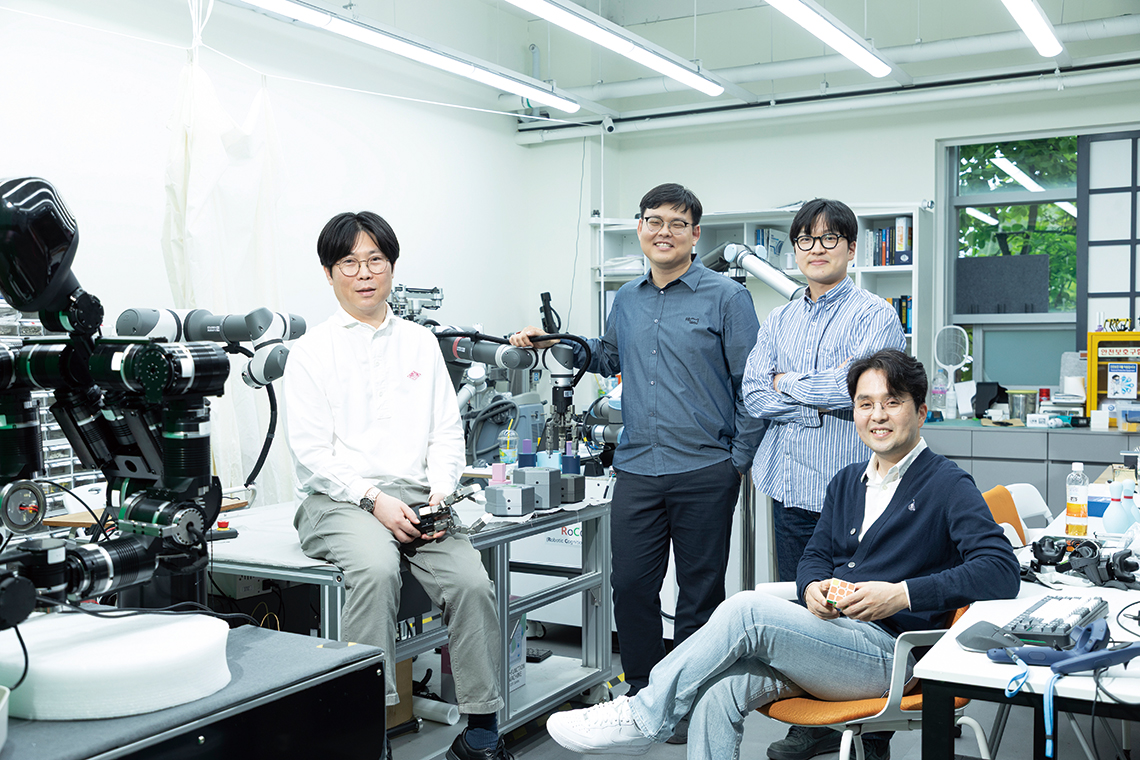
Professors JiHun Bae and SungOn Lee, Research Professor HyunSoo Shin, and Researcher GeunHu Lee
- Written by. YoungIm Park
- Photos by. HyeonGu Lee


Human-Like Manipulation Starts at the Fingertips
As Homo faber (meaning”Human as the creator”), humans evolved through their ability to create and use tools with highly dexterous hands. Now, humanoid robots are moving closer to deployment in more industrial settings and one of the greatest challenges is the “hand.” The robotic hand or gripper, which grasps and manipulates objects, is one of the most critical components in robotics.
“In industrial environments, we encountered a fundamental problem: different tasks require different gripper shapes and functions. Whenever a task changes, companies must either replace the entire gripper or configure a separate robotic cell. This is not only inefficient but also costly and time-consuming.”
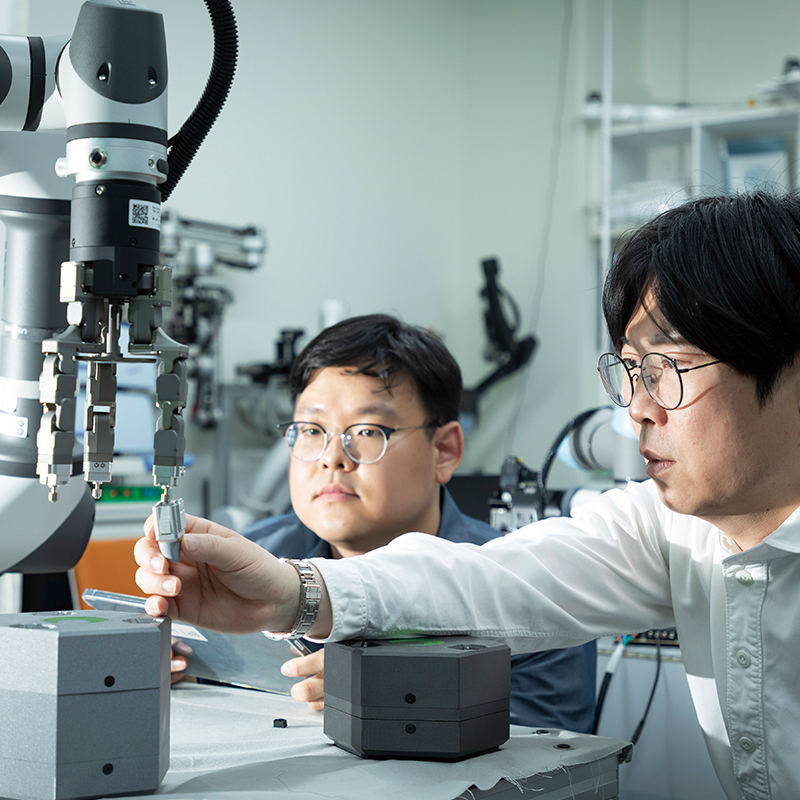
As a result of these challenges, the research team focused on the fingertip. In a robot, the fingertip is the part that comes into direct contact with an object, much like a human fingertip. Even with the same robotic hand, the type of fingertip attached determines the range of objects that can be grasped, the manipulation method, and the precision of the task. The researchers drew inspiration from the way humans work.
“The human hand is perhaps the most versatile gripper and manipulation tool. Not only can we grasp a wide variety of objects with a single hand, but we can also use tools of varying sizes such as tweezers, scissors, and screwdrivers, depending on the task. In other words, while the structure of the hand is important, the true essence of human manipulation lies in the ability to utilize the appropriate ”fingertips” and tools for a specific purpose. We began our research based on the idea that if only the fingertips could be replaced, rather than the entire gripper, robots could perform a much wider range of tasks.”
Versatility by Replacing Fingertips
The team's desire to improve efficiency and versatility by equipping grippers with task-specific fingertips and tools naturally led to a simple idea: replace only the fingertips rather than the entire gripper. The robot maintains its existing structure while changing only the “fingertips” to suit the task at hand. For example, a tweezer-shaped fingertip can be attached for precision grasping, while long and slender fingertips can be used in confined spaces. Specialized tools such as scissors or pipettes can also be mounted.
“This allows robots to go beyond simply grasping objects and to evolve into work platforms capable of actually using tools. Once commercialized, the technology could be applied across fields in manufacturing, logistics, laboratory automation, service robots, and humanoid robots. In the future, a single robot will be expected to perform multiple tasks, and the Finger-Tip Changer will become a key enabling technology to realize general-purpose robotic manipulation.”
Since 2024, the team has been developing the Finger-Tip Changer in collaboration with Tesollo, a company specializing in robotic grippers, to ensure that the technology can be applied in real industrial environments. Tesollo provided valuable insights from a commercialization perspective, particularly regarding durability and fastening stability for fingertips that must be repeatedly attached and detached in industrial settings. The collaboration has already moved beyond research. In November of last year, the team signed a technology transfer agreement with the company, Tesollo, which is now pursuing commercialization based on the transferred technology. The project serves as an excellent example of how ideas and foundational technologies developed in a university laboratory can be combined with a company's product-development expertise to create practical industrial solutions.
A Collaborative Team Bridging Robot Perception and Manipulation
The RoCogMan LaB is jointly operated by Professor SungOn Lee, whose expertise lies in robot perception, and Professor JiHun Bae, who specializes in robotic manipulation. Over the years, the lab has conducted research on a wide range of topics including robotic hand and gripper design, object grasping and assembly, and humanoid dual-arm manipulation technologies. Their primary focus is developing practical robotic systems that can be deployed in real industrial environments by integrating perception and manipulation technologies.
“Our next goal is to integrate the Finger-Tip Changer with humanoid robotic hands and dual-arm robotic systems. This will allow robots to select appropriate tools and fingertips according to the situation and to perform a wider variety of tasks with greater flexibility. We will continue pursuing research that enables robots to serve as practical work platforms that assist people in both industrial settings and everyday life.”
The study was recognized for its academic significance when it was accepted for publication on March 22 in IEEE Robotics and Automation Letters (RA-L), one of the leading international journals in robotics research.
MINI INTERVIEW
 HyunSoo Shin, Research ProfessorAI Convergence Research Institute
What was your role in this study, and what are your plans for future research?
HyunSoo Shin, Research ProfessorI was responsible for designing and analyzing experiments to quantitatively evaluate the performance of the Tip Changer, as well as analyzing the spring forces generated by the changing mechanism. Going forward, I plan to utilize a robotic hand developed to receive tactile sensor information through the Tip Changer. Using this system, I aim to develop methods that enable robots to estimate the optimal grasping posture when handling objects. The ultimate goal is to achieve more precise and stable manipulation.
What qualities do you believe are essential for early-career researchers?
HyunSoo Shin, Research ProfessorI believe a strong foundation is the most important quality. The ability to solve new problems comes from a solid understanding of fundamentals such as mathematics, physics, control theory, and mechanical design. While I strive to challenge existing approaches and explore new methods, I always make a conscious effort to strengthen those fundamentals.
My goal is not simply to develop technologies that work in research papers, but to create robotic technologies that can be applied in real industrial environments and the physical world. To achieve that goal, I will continue developing the engineering capabilities needed to transform ideas into practical systems and validate them in real-world settings.
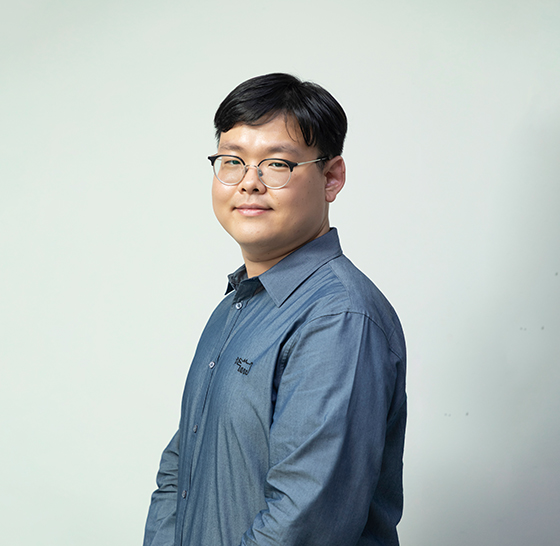 GeunHu Lee Ph. D. CandidateDepartment of Electronic Engineering, Class of 2021
How do you feel about having this paper published in a leading international journal with you as the first author?
GeunHu Lee Ph. D. CandidateIt is a tremendous honor to have a study that I led as first author accepted for publication in IEEE Robotics and Automation Letters (RA-L), one of the most prestigious journals in the field of robotics. Watching a mechanism that I designed being mounted on a robot and immediately seeing improvement in its performance is incredibly rewarding. Since this was my first time preparing a first-author paper, the process came with many challenges and unexpected twists, making the achievement feel almost uncertain. I consider this accomplishment “beginner’s luck” and will remain humble while using it as a stepping-stone toward becoming a researcher with world-class expertise.
What are your future research plans and long-term goals?
GeunHu Lee Ph. D. CandidateI plan to further develop the passive Finger-Tip Changer proposed in this study into an automated Tip Changer system that can be mass-produced for industrial applications. Beyond the hardware itself, I intend to integrate the system with adaptive manipulation algorithms capable of responding to diverse environments, thereby enhancing its level of completion.
My ultimate goal is to become a hands-on researcher who develops robust robotic systems capable of carrying out complex and diverse missions in challenging and hazardous environments without human involvement.