Lab & Center
Core Technologies of the Fifth Industrial Revolution
Cultivating Innovative Talent to Lead “Physical AI”
Education/Research/Industry-Centric Physical AI Education and Research Group
- Written by. YeongIm Park
- Photos by. YunJung Nam
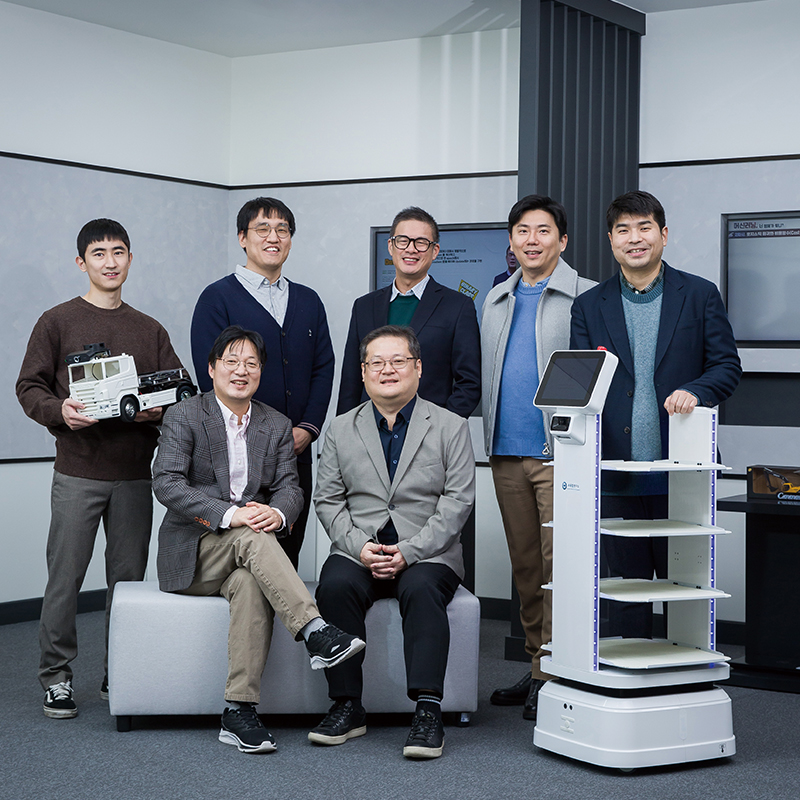 Faculty and students of the Education/Research/Industry-Centric Physical AI Education and Research Group


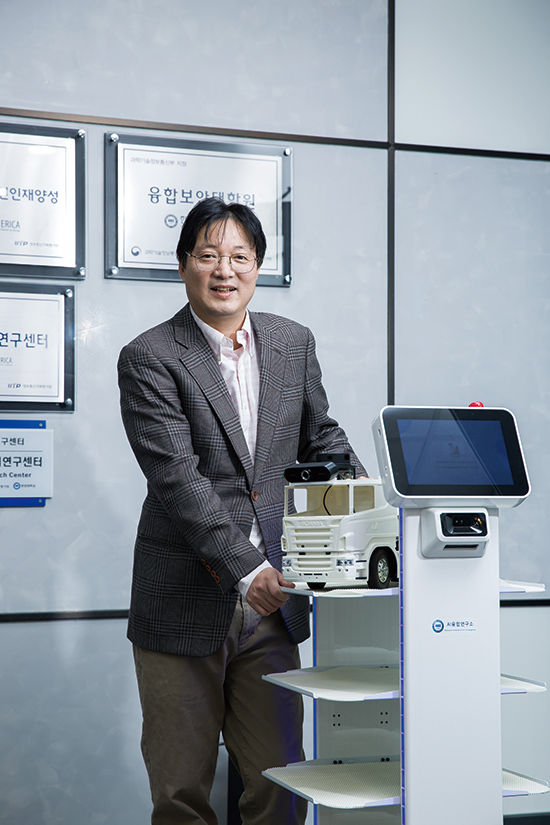 The Education/Research/Industry-Centric Physical AI Education and Research Group, led by Professor KyungTae Kang, received exceptional evaluations in the additional AI-field selection of the BK21 Innovative Talent Development Project. Seen in the photo is Prof. KyungTae Kang, the head of the group
ERICA as a Hub for AI and Robotics Research
Professor KyungTae Kang, head of the Education/Research/Industry-Centric Physical AI Education and Research Group, emphasized the importance of Physical AI technologies stating:
“A few years ago, the term ”Fourth Industrial Revolution” was the key theme shaping society. Now, there are growing discussions that we must prepare for the Fifth Industrial Revolution. In other words, smart factories are evolving from process automation to autonomation. At the center of this ”fifth industrial era” is Physical AI, which connects AI technologies to the physical world.”
Responding to this growing demand, the government has begun to strengthen its commitment to building a Physical AI-based industrial ecosystem to enhance global competitiveness. As the government positions Physical AI as a strategic priority, large-scale investment is expected in the areas of talent cultivation, research and development, and regulation improvement. As part of these efforts, last October the government added the AI field to the BK21 Innovative Talent Development Project, which is a national flagship program for nurturing experts in future industries. This additional designation, made possible through a supplementary budget allocation, is considered highly exceptional, highlighting the urgent national need for advanced AI specialists.
A total of 17 education & research groups applied and the final selection, based on comprehensive evaluation of educational capacity, research capability, and university-industry collaboration systems, was narrowed to two groups nationwide. ERICA’s Physical AI Education & Research Group was one of them. Although many groups applied with programs specialized in Physical AI, ERICA’s Education/Research/Industry-Centric Physical AI Education and Research Group (hereinafter referred to as ”the Physical AI Education and Research Group”) received overwhelmingly strong evaluations. Professor DongHo Lee of the Department of Applied Artificial Intelligence stressed that ERICA is the optimal school for cultivating Physical AI talent stating:
“Ansan, where ERICA is located, is promoting itself as a ”Robot City” and is actively fostering the advanced robotics industry. ERICA’s campus hosts many industrial partners, offering an ideal infrastructure for university-industry-research collaboration. Physical AI research requires industrial data and ERICA provides an excellent real-world environment for field testing and evaluation. It is also one of the few universities in the nation with a dedicated Robotics department.”
Because the group aims to cultivate core talent that will lead the transformation of robotics, manufacturing, and mobility industries, participating units include the Departments of Artificial Intelligence, Robotics, and Computer Science, and the School of Media, Culture, and Design Technology.
Professor WanSoo Kim of the Department of Robotics emphasized ERICA’s comprehensive research capabilities for robotics development stating:
“By integrating AI research with the Robotics Department’s accumulated work in sensors, control, and hardware, we can be a leader in the area of Physical AI technologies. Another strength is our well-established support infrastructure, including robotics testbeds.”
Optimal Infrastructure for Physical AI Talent Development
Through this BK21 project, ERICA will receive approximately KRW 800 million annually in research and education funding through 2027. With this support, the group will cultivate talent in Physical AI across three domains: education, research, and university-industry cooperation. Professor YoungHoon Kim of the Department of Applied Artificial Intelligence explained that the team designed the “ERICA Curriculum,” named after the campus acronym stating:
“We developed the curriculum using the following:
E: Emerging next-generation AI technologies
R: Robotics
I: Industrial manufacturing fields
C: Core AI theory
A: Automobility
Our primary focus is practical, validation-based education that solves real industry problems through collaboration with companies.”
The research domain will also prioritize developing practical Physical AI technologies through an education/research/industry-centric ecosystem. Professor YongJae Yoo of the Department of Applied Artificial Intelligence explained that the group will pursue five strategies to strengthen research capacity stating:
“We will fully support on-campus infrastructure that include entities such as the AI Convergence Research Institute, to discover industry and community problems and to conduct demand-driven convergent research, as well as promote collaboration with international partners and on-campus research institutes, and establish support systems for participating students.”
For example, participating students will receive research scholarships, funding for international academic activities, and opportunities for at least one annual international research experience (joint research or internships) with partner institutions such as UCLA, MIT, and 18 other overseas universities and research centers. Researcher MinHo Jung (Integrated MS-PhD Program, Department of Applied Artificial Intelligence), who joined the project, commented,
“I am pleased to conduct research under such favorable conditions. Participating in international collaborative research will not only strengthen my research capabilities but also give me opportunities to experience diverse cultures.”
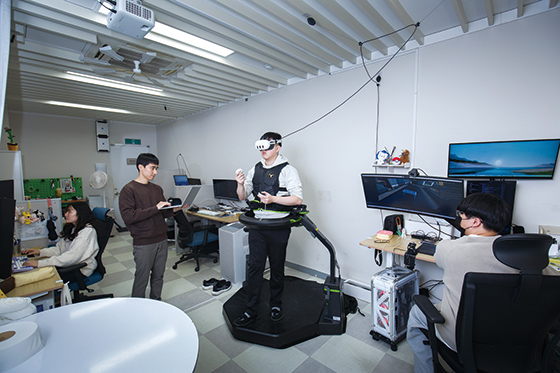
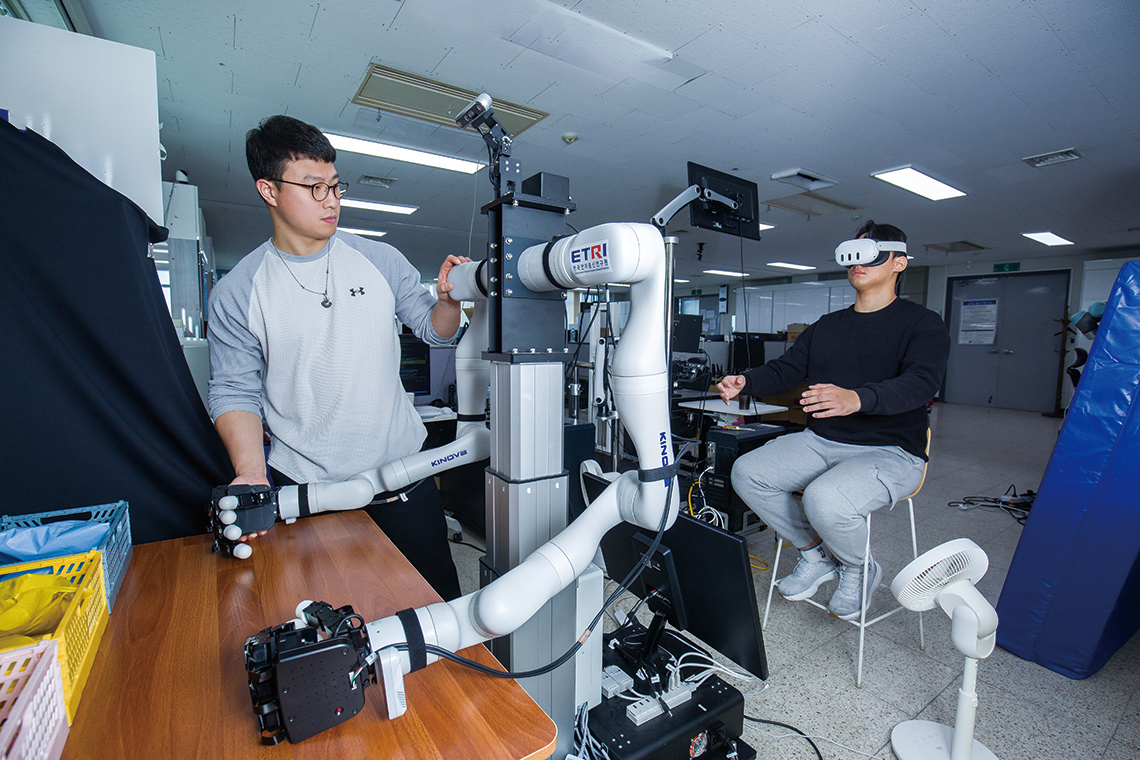 Laboratory of Professor WanSoo Kim of the Department of Robotics

We will focus on cultivating
practical talent in Physical AI,
the core technology
of the coming ‘Fifth Industrial Revolution’

Education and Research Fully Education/Research/Industry-Centric
The final domain is university-industry cooperation, which oversees both education and research initiatives. Professor WooSuk Lee of the Department of Computer Science emphasized that the group’s strength lies in designing educational programs and academic systems based on university-industry collaboration:
“We will expand cooperative courses where industry experts participate directly in teaching and evaluation, such as through IC-PBL+M. We plan to establish internship programs where students develop and apply solutions within companies. We will also activate the G-Capstone program, which allows internship experiences to substitute for thesis requirements. This is a groundbreaking BK21 policy that recognizes practical R&D as a legitimate graduation outcome.”
Through such collaboration-based educational systems, the group ultimately aims to cultivate practical talent who can readily enter industrial fields. This is why the group carries the name “Education/Research/Industry-Centric.” Professor KyungTae Kang also emphasized that support from local governments will be crucial to advancing Physical AI technologies. He said:
“Gyeonggi Province is currently pursuing the establishment of the Second Physical AI Center, and the Physical AI Education & Research Group will play an important role in helping Ansan City secure it. By attracting the Second Physical AI Center to the ERICA Campus, we aim to embed Physical AI into the region’s industries. Although Korea may trail in areas such as generative AI and foundation models, we will make every effort to ensure that Korea becomes a leader in Physical AI.”