Got the Classes
Creator with Adaptability,
Nurturing All-Rounders through Convergence
College of Software Convergence, Department of ICT Convergence
- Written by · Lee Yeon-joo
- Photo by · Ryu Chang-ryul


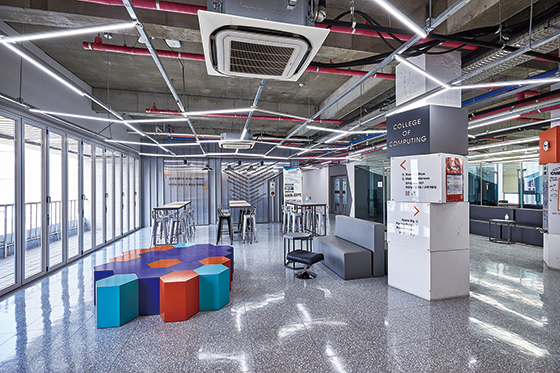 IC-PBL Open Space
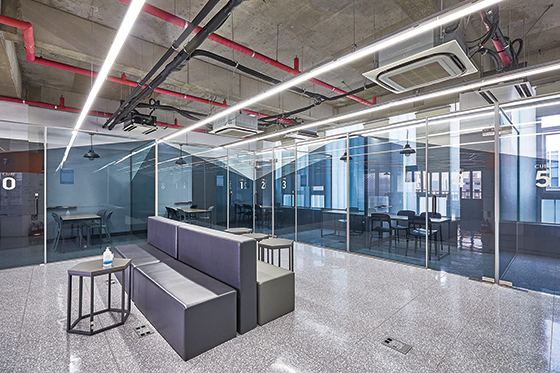 Thinking Cube
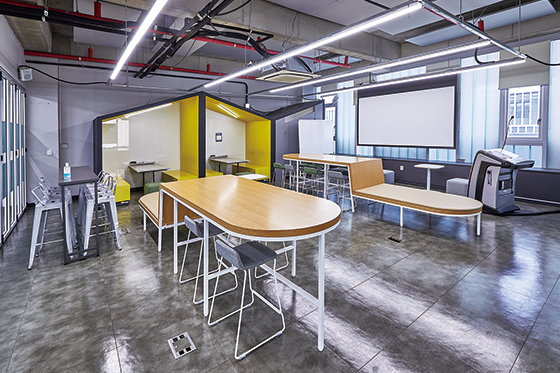 Space Big

Three majors, nine tracks
| Major | Media Technologies | Cultural Technologies | Design Technologies |
|---|---|---|---|
| Track |
|
|
|
| Possible Career Fields |
|
|
|
| Imagine the FuturePioneer an undiscovered world of new future technologies with with imagination | Make the UnthinkableImplement creative services and products through the convergence of media, culture, design, and software | Prosper with InnovationLead the field of innovative convergence encompassing the humanities, arts, and physical education | |

|

|

|
Complete your own portfolio with HCI
The Department of ICT Convergence offers three majors, namely Media Technologies, Culture Technologies, and Design Technologies, which are all based on HCI or human computer interaction. and each major operates three distinctive tracks. The strength of the program is in its highly qualified faculty who hail from various fields and cover a broad range of areas. This is especially important at present as it is becoming increasing more challenging to predict the speed of change. ERICA's ICT Convergence Department offers a broad spectrum of convergence courses compared with other colleges. Dean Gyou-hyung Kyung of the College explained, “It is rare to find a department that encompasses all fields of humanities, design, and engineering,” emphasizing the convergence of knowledge offered by the program.
The greatest strength of the ERICA ICT Convergence Department is that it operates an HCI-based curricula. HCI is the study of interactions between humans and computers and is used to help improve the interactions between users and computers (here, ”computer” is used to refer to a generic term covering all electronic tools used by humans including computers, products, and machines) to provide a better user experience. As the nine tracks within the three majors are also based on HCI, students gain basic computer science skills. In the first and second years, they intensively learn about basic coding, hardware, and design. Starting in their second year, students will take courses specific for their selected track. If they wish, they can take courses from other tracks. Dean Gyou-hyung Kyung commented, “The ICT Convergence Department is a vessel that will bring together diverse fields.” Since the department started through the PRIME Project in 2016, it has been operating with the highest priority on practical education and research required by society and industry. The department will continue to operate its current majors and tracks following societal demands.
“AI and ChatGPT are emerging trends these days. Also, in a recent article it was reported that a metaverse version of a theme park attracts more people than the real version. We plan to reinforce our program tracks related to AI, games, and AR/VR/XR. With these fields in high societal demand, we plan to operate our track system flexibly and in line with the times to create a more effective undergraduate program that reflects the needs of industry, society, and students,” Dean Kyung said.
Diverse experiences in convergence will eventually become an indispensable foundation for students when creating their own portfolios. To create an environment that encourages creativity and proactive engagement, the infrastructure of the undergraduate programs are being designed to focus on communication. That is also why the PBL, startup, and capstone design courses are being emphasized. Combined with the infrastructure, courses on theories and practices are expected to further develop students’ individual capabilities.
“We have launched and are operating a total of six capstone courses for second to fourth year students. The most important aspects in this process are self-direction and teamwork. The process of conceiving and materializing ideas of students by themselves is stressed as an important process within the department,” commented Dean Kyung.
An undergraduate education that emphasizes interaction between humans and technology encourages students to develop creativity and ideas. Accordingly, students often make advancements in various career fields including in large corporations, IT companies, and design companies. Some students even launch their own startups. The Department of ICT Convergence is a popular department for students who dream of starting a business. Faculty members, including professors focusing on industry-university cooperation, provide practical advice and ongoing coaching for students interested in startups.
We plan to operate our track system
flexibly in line with societal demand and the times

Faculty of ICT Convergence are creating something greater
Yeon-su Lim, a student in the Department of Information Society and Media, is concurrently studying Design Technologies in the Department of ICT Convergence as a double-major. Lim said that his interest in UX (user experience) and HCI studies was the motivation to join.
“First of all, I was able to acquire competencies in a variety of fields needed to advance into HCI and user experience fields. My professors have all been very helpful and enthusiastically guide students, which has helped me more than anything,” she said.
Lim has been taking classes at the Department of ICT Convergence since her second year and plans to graduate next year. She is considering the field of UX research as her future career path, although she is still leaving various possibilities open. At first, her involvement started as a simple interest in the IT industry, but as she learned more about various fields in her classes, she discovered a career direction in convergence.
Yoon-seong Kim is a student in the Department of Industrial and Management Engineering and is not a double-major. He is a member of a laboratory in the Department of ICT Convergence, which studies artificial intelligence and data along with human factors engineering.
“The field of industrial engineering deals with human factors engineering as well. I thought it was interesting that the ERICA has human factors engineering as part of the ICT Convergence department. The Department of Industrial Management Engineering, to which I belong, deals with data analysis, but I joined the ICT Convergence Department lab because I am hoping to get a data analysis job at an IT company.”
The Department of ICT Convergence is a popular department among students looking for double-majors. Perhaps one of the reasons for its popularity is the anticipation that societal demand will increase in the future for those with majors in the convergence field. As national policies for fostering convergence are being announced regularly, students who are looking for something more than their present major are showing interest in the ICT Convergence Department.
Fields in the spotlight change according to the times. Those who diligently prepare for their careers in the midst of a large trend in an industry are the ones who are highly motivated. The Department of ICT Convergence offers a high-tech education that meets societal demand. Thus, students in the program should be able to effectively prove their skills in connection with industry trends on their portfolio. The education provided, which contributes to human life through technology and expands by integration, is the reason many are increasingly paying attention to the role and progress of the ICT Convergence Department.
Be the hero of a life that you live passionately
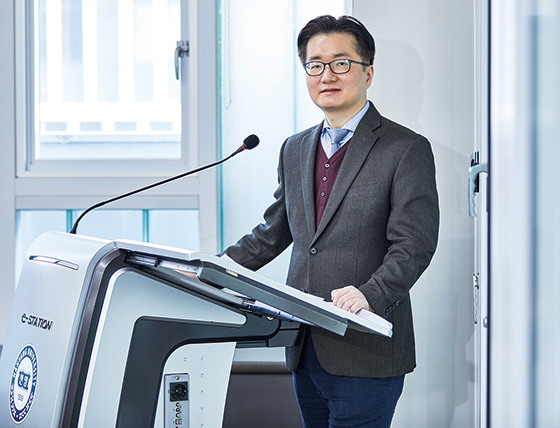
Gyou-hyung Kyung, dean of the ICT Convergence department
“Interaction” and “design” are two keywords that describe the Department of ICT Convergence. Design can be interpreted as artistic design or engineering design. In today’s world, we need engineers who understand art and designers who understand engineering. In other words, we live in an era where we have to put a fence around our field while constantly exploring other fields. Open-mindedness is key because we need to accept and adapt to new fields. Remembering the rule of 10,000 hours, students must invest enough time and effort instead of giving up halfway to perfect their skills in their field. By doing so, students will be able to design their lives the way they want. I truly hope that all Hanyangians and prospective students will be able to do that.